AI Digest — July 25, 2026, 9 AM
Summary
The day is overwhelmingly about Claude Opus 5, and the three sources covering it converge on the same tension: Anthropic’s own benchmarks show it beating Fable 5 at half the cost, yet its messaging hedges to “comes close,” exposing how far evals lag behind perceived real-world capability — a gap Epoch’s near-tied ECI scores and the FrontierCode effort anomaly both dramatize. Underneath the launch hype runs a second, structural thread from the AINews issue: a widening split between open-weight advocates (NVIDIA, Meta, Microsoft, DeepSeek) and closed frontier labs (Anthropic, OpenAI, Google), the very labs whose release is dominating the headlines. Meanwhile the DevCon talks from Farley and Šelajev sound a quieter, cautionary counterpoint — that durable engineering discipline and hard sandboxing still matter precisely because these increasingly capable agents are being turned loose to code and drive machines on their own.
Claude Opus 5 Benchmarks: Fable 5 Performance at Half the Cost

Anthropic's new Claude Opus 5 comes within striking distance of Fable 5's outputs at roughly half the price — $5 per million input tokens and $25 per million output — and on many benchmarks (agentic terminal coding, knowledge work, agentic search) it beats Fable outright, trailing only on multidisciplinary reasoning, legal, and health. On Cursor Bench 3.2 it landed within 0.5% of Fable 5's peak at half the per-task cost; Fable only pulls ahead at absolute maximum effort, a setting most users never touch. The author argues the more important story is the generational leap from Opus 4.8 — a genuine step up rather than a polish pass — meaning existing Claude users get a better model for less, which "basically never happens." Three concrete gains stand out: stronger code-generated visual output (3D SVG/HTML, wind-tunnel sims), much better self-verification on long-horizon looping tasks, and guardrails that are 85% less likely to misfire than Fable's while still present.
Read the source →Dave Farley - Vibe Coding - Is this really the best we can do? - AI Native DevCon June 2026
Closing out AI Native DevCon, Dave Farley pushes back on the idea that "vibe coding" is the endpoint of agentic programming, arguing that the disciplines and behaviors that have stood the test of time remain important even amid a genuine sea change in how software is produced. He frames AI adoption in programming as hugely disruptive but insists that many durable engineering practices should carry forward rather than be discarded. He notes he isn't alone — several other speakers that day made similar points — and sets out to question assumptions about the new agentic world and examine why the durable fundamentals still matter. (Transcript is truncated in the raw materials, so the full argument and specific recommendations are not captured here.)
Read the source →Oleg Šelajev - You're absolutely right, it was your home directory! - AI Native DevCon June 2026
Oleg Šelajev of Docker's DevRel team presents on sandboxing and isolating AI agents, motivated by Docker's push to find its place in the CI ecosystem and its recent sandboxing initiative. The session targets developers who write agents that run locally on their own machines, walking through why and how to isolate those AI workloads to avoid the kind of accidents the talk's title jokes about — an agent wiping your home directory. Šelajev, formerly of Zero Turnaround and Atomic Jar (maker of Testcontainers, acquired by Docker), frames local agent isolation as the practical safeguard needed as you let AI do more autonomous work. (Transcript is truncated in the raw materials, so the concrete tooling and steps are not fully captured here.)
Read the source →v2.1.220
This is a release of Claude Code, Anthropic's agentic coding tool that runs in the terminal, understands your codebase, and executes routine tasks, explains complex code, and handles git workflows through natural-language commands. The published release notes for v2.1.220 could not be extracted — the GitHub release page returned repeated "There was an error while loading. Please reload this page." messages instead of the changelog. As a result the specific fixes, features, or changes in this version are not available from the captured content.
Read the source →[AINews] Claude Opus 5: Fable-level performance at Opus price (half Fable)
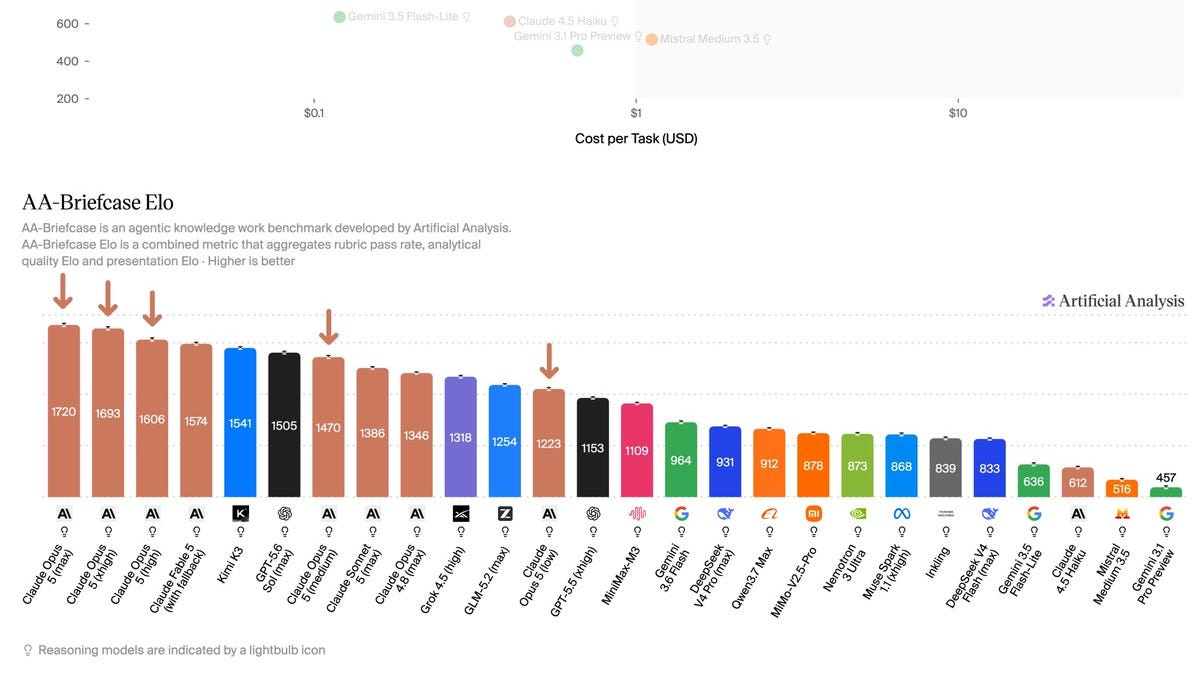
In a rare Friday release, Opus 5 dominated the news; although most of Anthropic's official benchmarks technically show it beating Fable, the company's messaging still says it only "comes close," which Latent Space reads as a reflection of eval limitations rather than real inferiority — the unmeasurable "big model smell" Anthropic knows Fable retains. Independent evaluations, they note, confirm the outperformance, and the efficiency story beyond pricing matters too, though on efficiency Opus 5 only just matches GPT 5.6 Sol. Epoch pegged Opus 5's ECI at 159, slightly below Fable 5's 161, while matching Fable on SWE-ECI at 161; critics like @scaling01 called that only +1 point over Opus 4.8 and "incredibly underrated," pushing for harder public benchmarks. A flagged irregularity from @jerhadf: Opus 5 scored better on FrontierCode at medium effort than at high effort, hinting at evaluation instability rather than smooth gains from more inference compute, while users praised its coding and browser-driving agentic behavior.
Read the source →Opus 5
This AINews issue (covering 7/23–7/24) leads with Claude Opus 5's launch and the mix of benchmark scrutiny and coding-agent praise it triggered, then pivots to a major open-weights policy fight. More than 20 companies — NVIDIA, Meta, Microsoft, Palantir, Hugging Face, IBM, Mozilla, Mistral, a16z, Dell, Y Combinator — signed Microsoft's "Open Weights and American AI Leadership" letter urging policymakers not to prematurely restrict open-weight models, notably without OpenAI, Anthropic, or Google, framing an industry split between open-ecosystem players and closed frontier labs. Elon Musk and Jensen Huang publicly backed the letter, and commenters read the pro-open coalition as already out-gunning the closed-model lobby. Separately, a translated compilation of 52 remarks from DeepSeek founder Liang Wenfeng says DeepSeek is optimizing for AGI research probability over user growth or commercialization, prioritizing coding/general agents then continual learning and self-iteration, releasing the same models it runs internally, and framing the China–US gap as compute-bound rather than talent-bound.
Read the source →