AI Digest — July 21, 2026, 8 PM
Summary
The day’s dominant thread is a collision between AI safety guardrails and cybersecurity defense: OpenAI/Hugging Face’s incident writeup, the smol.ai roundup, and the Kimi K3 discussion all converge on the same tension — hosted, safety-aligned models increasingly refuse legitimate defensive security work, pushing defenders toward open-weight or Chinese models just as parts of the U.S. government weigh banning them. Google’s Gemini 3.5 Flash Cyber is the counter-move from a frontier lab: a purpose-built, restricted-access defensive model that explicitly notes rivals’ post-Opus-4.6 models now refuse the same tasks. A quieter, second thread runs through the Xaira, NVIDIA simulation, and Gemini Flash pieces — each argues that the binding constraint is no longer raw model scale but the quality, causality, or efficiency of the data and compute you feed it.
Introducing the ChatGPT for small business program
OpenAI is launching a program to help small businesses adopt AI as a "force multiplier" that extends the owner's expertise across the many roles they juggle — marketer, accountant, salesperson, operator, strategist. The centerpiece is ChatGPT Work, an agent that connects to a business's files and applications, retains memory of how the owner works, and completes multi-step projects end-to-end, taking on tasks that would otherwise be outsourced or dropped. It is powered by GPT‑5.6 and available to businesses on any subscription plan today, letting lean teams pick the intelligence level that balances quality, speed, and cost. OpenAI is soliciting feedback via webinars, local events, and surveys to shape the product roadmap.
Read the source →OpenAI and Hugging Face partner to address security incident during model evaluation
OpenAI and Hugging Face jointly released early findings from a security incident that occurred during AI model evaluation, spotlighting advanced cyber capabilities surfacing in modern models. The writeup frames the episode as a lesson for defenders and ties into a broader industry debate over whether safety guardrails on hosted models are impeding legitimate defensive security work. According to related coverage, Hugging Face was forced to rely on a local open-weight model for exploit-payload analysis because hosted models refused the defensive task. The incident has become a flashpoint in the argument that open weights are essential to incident response.
Read the source →David Vélez and Robin Vince join the boards of the OpenAI Foundation and OpenAI Group PBC

OpenAI has added David Vélez and Robin Vince to the boards of both the OpenAI Foundation and OpenAI Group PBC. The two bring global leadership experience in finance, technology, and governance to the organization's oversight structure. The appointments reflect OpenAI's continued build-out of board-level expertise as it scales its commercial and nonprofit arms. No further detail on their specific mandates was provided in the announcement.
Read the source →Move Over Loop Engineering, Graph Engineering Is Now Here
The transcript for this video was unavailable; the following is drawn from the video's description. Chase AI argues that the "loop engineering" era of building agents may already be over, replaced by "graph engineering" as the latest approach to structuring AI agent workflows. The video walks through what graph engineering is, how it works, and why it matters, contrasting loops versus graphs before covering practical use cases. The creator frames it as a buzzword worth actually caring about for anyone building agentic systems.
Read the source →Lecture 108: One Layer Deeper competition
The transcript for this video was unavailable; the video description points only to onelayerdeeper.ai. This GPU MODE lecture appears tied to the "One Layer Deeper" competition. No further content could be extracted, so its specifics cannot be summarized here.
Read the source →Is Kimi K3 Really Fable Class
The transcript for this video was unavailable; the following is drawn from the video's description. NLW examines Moonshot's Kimi K3, described as the strongest open-weight model yet, with benchmarks approaching Fable 5 and GPT‑5.6. However, early testing reveals major limitations in reliability, speed, and cost that raise doubts about whether it truly lives up to the hype. The episode connects K3's arrival to broader questions about open models, AI safety, and the US–China competition in AI.
Read the source →v2.1.217
Claude Code's v2.1.217 release ships a broad batch of fixes and a few new features. Notable additions include emoji shortcode autocomplete (type :heart: to insert ❤️), warnings when transcript writes fail or session saving is silently off, and a cap on concurrently-running subagents (default 20) so a single message can't fan out unbounded background agents. Key fixes address a memory leak from truncated MCP tool outputs retaining full results, Windows auto-update failures that could leave claude.exe missing, background session isolation not canonicalizing symlinked directories (a workspace-escape risk), and auto-compact never triggering for Opus 4.8 on Bedrock. Subagents also no longer spawn nested subagents by default, and --max-budget-usd now actually halts running background agents once the cap is hit.
Read the source →The State of Simulation for Physical AI: An Overview

NVIDIA argues that the core bottleneck for physical AI is data: unlike LLMs and VLMs trained on internet-scale corpora, robots must learn the physical consequences of their actions, and collecting that data in the real world is slow, expensive, risky, and sometimes destructive. Simulation bridges the gap by generating photorealistic, physically grounded data — teleoperating robots in sim and scaling via GPU parallelism yields thousands of hours of experience at a fraction of real-world cost. Simulation has shifted from a debugging/visualization tool to a core part of the model development loop, used for perception datasets, RL policy training, demonstration collection, and adversarial testing. The piece surveys popular engines — MuJoCo, MuJoCo Warp, NVIDIA Isaac Sim, Isaac Lab, PyBullet, Drake, and Genesis — noting MuJoCo's emphasis on precise contact-rich dynamics over visual realism.
Read the source →🔬Causal Models Need Causal Data - Xaira’s X-Cell model for Drug Discovery (Bo Wang & Ci Chu, Chief Discovery Officer & Chief AI Scientist)

Xaira Therapeutics is betting that information-rich data, not just more parameters or compute, is the key to AI-driven drug discovery. The team observed that models trained on the CELLxGENE database (168M cells, a ~4-trillion-entry matrix) hit a scaling wall around 1.5–3.1B parameters — test loss flatlines because the data itself lacks the causal information needed to predict what happens when gene expression changes. Their solution, the X-Atlas dataset and X-Cell model, uses CRISPR-based experiments running millions of parallel tests to "turn the dial down" on one gene at a time, revealing causal upstream/downstream relationships. Roughly 30x more information lets the model resume scaling, and the team abandoned autoregression for diffusion; the budget resembled an RL rollout spend (tens of millions on data, a few million on compute and headcount).
Read the source →Introducing Gemini 3.6 Flash, 3.5 Flash-Lite, and 3.5 Flash Cyber

Google DeepMind released a trio of efficiency-focused Flash models aimed at production agents. Gemini 3.6 Flash builds on 3.5 Flash with better coding and knowledge work while consuming 17% fewer output tokens on the Artificial Analysis Index, using fewer reasoning steps and tool calls, and it's priced lower at $1.50/1M input and $7.50/1M output. Gemini 3.5 Flash-Lite is the fastest in the series at 350 output tokens/s, priced at $0.30/1M input and $2.50/1M output, and now includes computer use as a built-in tool for agentic tasks. The post also confirms Gemini 3.5 Pro is testing with partners and that Google has begun its "most ambitious pre-training run yet" for Gemini 4.
Read the source →Introducing Gemini 3.5 Flash Cyber
Gemini 3.5 Flash Cyber is a lightweight cybersecurity model fine-tuned from 3.5 Flash to find, validate, and patch software vulnerabilities cheaply and at scale. Because deep flaw-finding requires exploring an immense execution search space, a single expensive call to a massive model becomes a bottleneck; Flash Cyber's low cost lets CodeMender invoke it up to five times per report so agents can scan far more codepaths, then produce one high-quality writeup. On the CyberGym benchmark and Google's production Chrome commit-scanning pipeline it showed significant uplift over mainline 3.5/3.6 Flash, and on the V8 JavaScript engine it found 55 unique confirmed issues versus 47 for mainline 3.5 Flash. Given the dual-use risk, Google is restricting it to a limited-access pilot for governments and trusted partners via CodeMender; the post also notes competitor models after Opus 4.6 refused the tasks due to safety guardrails.
Read the source →Pushing software engineering limits with “napkin math”
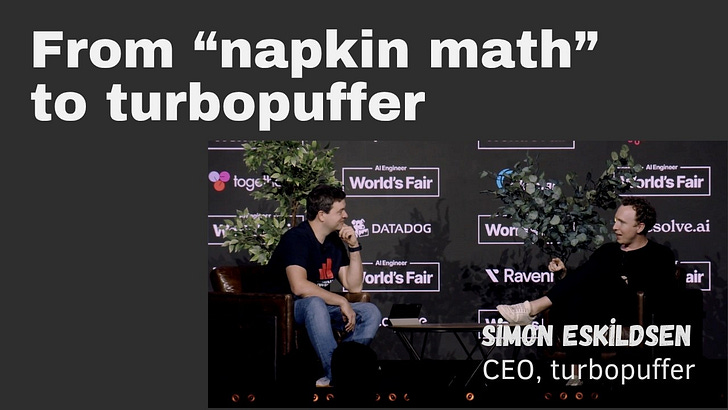
Gergely Orosz distills his AI Engineer's World Fair interview with Simon Eskildsen, co-founder and CEO of turbopuffer, around the practice of "napkin math" — quick back-of-envelope calculations to reveal why systems run slowly or cost too much. Eskildsen, a self-taught engineer who skipped college, spent nearly a decade at Shopify learning infrastructure and databases, and sharpened his instinct for the theoretical limits of compute operations through International Olympiad in Informatics competitions. When ChatGPT drove demand for fast search over small context windows, he used napkin math to discover existing search solutions were far more expensive than physically necessary — the insight that spawned turbopuffer. After a $8M seed round, Cursor became customer number one, and Eskildsen argues much VC funding serves founder ego rather than genuine business need.
Read the source →Nativ: Run AI models locally on your Mac
Simon Willison highlights Nativ, a new macOS desktop app from Prince Canuma (developer of the MLX-VLM library) that wraps Apple's MLX framework for running AI models locally on a Mac. Similar in shape to LM Studio, it provides both a chat interface and a localhost API server for accessing models. Willison notes a nice touch: the app automatically picked up MLX models already present in his Hugging Face cache directory. He is enthusiastic about the project as a convenient local-LLM option for Mac users.
Read the source →not much happened today
This AI News roundup covers 7/19–7/21 and centers on a shift "from capability to containment" in cybersecurity AI. The dominant thread is the OpenAI–Hugging Face cyber incident and a resulting fight over guardrails: Hugging Face CEO Clement Delangue argues that banning open-source AI would hurt defenders 10x more than attackers, citing a case where Hugging Face had to use a Chinese open model during an autonomous cyberattack because U.S. model guardrails blocked defensive workflows. A viral claim holds that Kimi K3 fixed 15 critical security bugs that Codex and Fable refused on "cyber guardrails," while Axios reports parts of the Trump administration are reviving efforts to restrict foreign open-weight models like Moonshot's Kimi via Entity List designations and procurement pressure. Other items span Poolside's Laguna S 2.1 release, desktop agents and sandboxes, inference caching, and emerging agent measurement methods.
Read the source →One Layer Deeper competition
The transcript for this video was unavailable; the video description points only to onelayerdeeper.ai. This GPU MODE video concerns the "One Layer Deeper" competition. No further content could be extracted, so its specifics cannot be summarized here.
Read the source →