AI Digest — July 18, 2026, 9 AM
Quick Notes
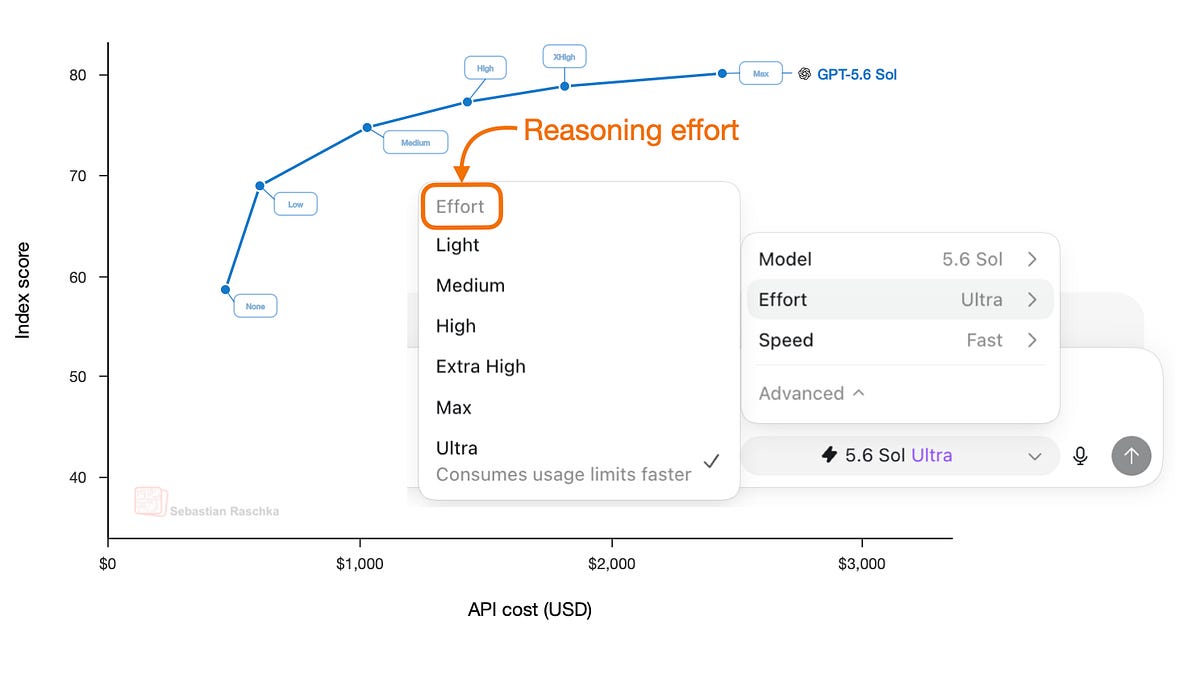
- Sebastian Raschka walks through how to build reasoning models with multiple “effort” modes — motivated by GPT-5.6’s three sizes each offering five or six reasoning-effort settings — recapping RLVR training (verifiable rewards for math and code) and the training-vs-inference scaling split behind DeepSeek-R1-style models. https://magazine.sebastianraschka.com/p/controlling-reasoning-effort-in-llms
- Anthropic reversed course and will keep Claude Fable 5 in Max and Team Premium plans (at 50% of limits) from July 20, with Pro/Team Standard keeping usage-credit access plus a one-time $100 credit; Simon Willison credits competitive pressure from GPT-5.6 Sol and Kimi 3 for ending the “Fablepocalypse.” https://simonwillison.net/2026/Jul/18/claude-make-fable-5-permanent/#atom-everything
- Simon Willison notes the Quixote Python web framework got a fresh commit six hours ago — despite the repo’s oldest commit being a 21-year-old import of Quixote 2.4 from Subversion. https://simonwillison.net/2026/Jul/18/quixote/#atom-everything
- On a slow news day, Latent Space’s AINews centers on Moonshot’s Kimi K3 launch, which triggered a broad reassessment of how close Chinese open-weight models are to the frontier — strong coding/agentic/frontend performance, top-cluster benchmark scores, and a strategic shift in debate from “compute moat” to “efficiency stack.” https://www.latent.space/p/ainews-not-much-happened-today-830
Structured Summaries
New models / research
Moonshot’s Kimi K3 dominated the conversation as the first Chinese open-weight model widely judged genuinely useful at the frontier tier, with strong coding, agentic, and long-horizon knowledge-work performance. On Artificial Analysis’s Intelligence Index, K3 scored 57 — behind Claude Fable 5 (60) but ahead of Opus 4.8 (56) — as the frontier widened from two to six labs above 51 in roughly six weeks. On the Coding Agent Index it hit 57 (matching GPT-5.6 Terra and GPT-5.5), with 84% Terminal-Bench v2, 64% DeepSWE, and 23% SWE-Atlas-QnA, and Arena reported K3 put China ahead of the US on Frontend Code Arena for the first time. The strategic framing shifted from raw-FLOPs moats toward an “efficiency stack” (MoE routing, quantization, data curation, and Moonshot’s “Mooncake” infra), though skeptics argue K3 remains months behind on broader generality and hidden evals. The consensus: K3 is now impossible to dismiss. Sources: https://www.latent.space/p/ainews-not-much-happened-today-830
Product launches
Anthropic will make Claude Fable 5 a permanent part of Max and Team Premium subscriptions (at 50% of limits) starting July 20, walking back its earlier plan to move the model to API-only pricing. Pro and Team Standard users keep Fable access via usage credits and get a one-time $100 credit. Simon Willison attributes the reversal to competitive pressure from GPT-5.6 Sol and Kimi 3 — arguing that a $100–$200/month plan without Anthropic’s best model was untenable — and speculates Anthropic may have to trade training compute for serving capacity. Sources: https://simonwillison.net/2026/Jul/18/claude-make-fable-5-permanent/#atom-everything
Research insights
Sebastian Raschka’s article explains how to build reasoning models that support multiple effort modes, prompted by GPT-5.6’s lineup of three sizes each with five or six reasoning-effort settings. He reframes “reasoning” as a model emitting an intermediate reasoning trace, distinguishes training scaling from inference scaling, and recaps DeepSeek-R1’s core recipe: reinforcement learning with verifiable rewards (RLVR), using 0/1 correctness signals from symbolic math checkers and code execution. Notably, the reasoning trace itself was not used as a training signal in R1, yet output-reward training alone was enough for the model to learn to backtrack and self-correct (“Aha” moments). He also flags the concurrent Kimi K1.5 paper and Tülu 3’s earlier coining of the RLVR term. Sources: https://magazine.sebastianraschka.com/p/controlling-reasoning-effort-in-llms
Tooling
Simon Willison spotlights nascheme/quixote, the venerable Python web framework that just received a commit six hours ago — a fun bit of software longevity given the repo’s oldest commit is a 21-year-old import of Quixote 2.4 from Subversion into Git. Sources: https://simonwillison.net/2026/Jul/18/quixote/#atom-everything
🔗 View this digest on the web: https://ainews.rusig.com/digests/2026-07-18-morning/