AI Digest — July 7, 2026, 8 AM
Quick Notes
- Hugging Face + SkyPilot now offer zero egress storage, allowing teams to mount any Hub repo as a local path with
hf://URLs and run compute where GPU capacity exists without paying cross-cloud transfer fees — https://huggingface.co/blog/skypilot-hf-storage

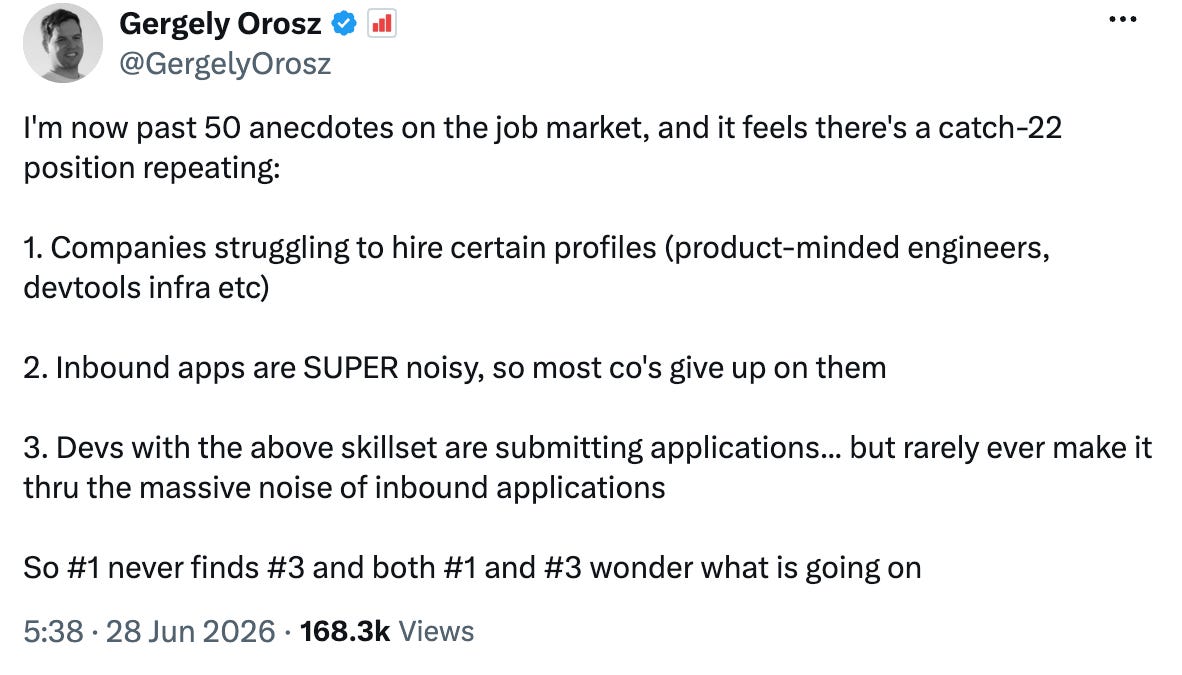
- The Pragmatic Engineer breaks down the 2026 tech jobs market: hiring managers struggle with AI sloop applications while senior engineers barely get replies, creating a “Catch-22” that’s particularly acute in non-AI roles where comp has reset to multi-year lows — https://newsletter.pragmaticengineer.com/p/tech-jobs-market-in-2026-part-3-hiring
- Microsoft Foundry now hosts Hugging Face models on its Managed Compute platform with a curated catalog refreshed weekly, bringing enterprise security and governance to open-weight models deployable in one click alongside frontier options from Azure — https://huggingface.co/blog/microsoft/foundry-managed-compute

- Claude Cowork is expanding to mobile and web platforms with significant improvements: executives still view AI as early-stage chat tools while non-engineers are rapidly adopting terminal and cloud code, driving massive organizational throughput gains even without elite models — https://www.youtube.com/watch?v=XNbc2HhL7J4
- DoorDash has deployed Cloud Code across its entire organization to “raise the floor” of AI fluency; executive leader Yuen reports a major comeback after years away from coding himself, as non-engineers at every level build and ship production code while executives recognize connecting tools like Calendar or Slack makes knowledge work significantly more efficient — https://www.youtube.com/watch?v=hyqLNX3VExQ
- The Field Guide to Fable keynote explores new model behaviors with four segments: unhobbling Claude by changing constraints, finding unknowns through blindspot passes and brainstorming wildly different designs; dealing with grief as weeks-of work compresses into hours; being unreasonable about accepting tradeoffs when models genuinely deliver on fast/good/cheap — plus AINews coverage of Tencent Hy3 Apache 2.0 release competing with GLM-5.2 in reasoning, coding, agentic tasks while providing ready-to-go vLLM-native inference support from launch — https://www.latent.space/p/ainews-the-field-guide-to-fable

Structured Summaries
Product Launches & Platforms
Microsoft Foundry x Hugging Face Models Collection: Managed Compute for Open-Weight Models (https://huggingface.co/blog/microsoft/foundry-managed-compute) At Microsoft Build 2026, the announcement combines two complementary services. First, Hugging Face models on Foundry — a curated subset of open-weight models directly accessible from the HF ecosystem via foundry’s Model Catalog and refreshed weekly. Weights are pre-staged in Azure; every model runs with enterprise-grade security scanning, governance policies, observability dashboards, billing integration, and Microsoft-manaked runtimes (vLLM or SGLang on Foundry Managed Compute). Second, Hugging Face Models Collection deployment options beyond pay-per-token and provisioned throughput. The Managed GPU platform as a service handles the operational layer: discovery workflows replace manual license review; multi-stage publication pipelines remove CVE patching burdens from developers who previously built custom images for each model version they needed to run in production environments behind enterprise-grade endpoints.
Hugging Face Storage + SkyPilot Cloud Compute (https://huggingface.co/blog/skypilot-hf-storage)
The HuggingFace team joins SkyPilot with a zero egress option, so models and datasets stay on the Hub while compute runs where GPU capacity exists in another cloud or cluster entirely. The store: hf backend exposes any HF repo via an hf:// URL alongside S3/GCS/Azure/R2 mounts using Hugging Face’s hf-mount FUSE driver which streams reads lazily, so training can start immediately without blocking on full downloads even when iterating a dataset across epochs with GPU busy billing while streaming in rather than downloading everything at once. Teams already juggling reserved capacity across multiple cloud vendors to avoid paying egress between their data buckets and inference servers can now consolidate workflows under one hf:// scheme which covers reading, checking points training publishing back to repositories serving from whatever free cluster allocation is available today or tomorrow as the next generation hardware generations come online without migration costs.
Research & Methodology Guidance
The Field Guide to Fable: Understanding First-Generation Fabel-Class Model Behaviors (https://www.youtube.com/watch?v=XNbc2HhL7J4) This keynote maps four key behaviors users must learn when migrating from frontier models into the new generation, starting with unhobbling Claude by updating and loosening constraints that were previously imposed to guide model behavior: “the harness we put them in” includes US prompts designed to limit capabilities. Most people agree now on what makes HTML effective for controlling agent output; removing old knowns lets users elicit behaviors they’d never see before because previous generations of models had been overly limited by their constraints. Second, finding your unknowns — a blindspot pass reveals gaps between map and territory that you didn’t even know existed alongside references to migration notes and keeping implementation-notes.md as running logs for underspecified decisions made on behalf of teams transitioning workflows into the new capability envelope. Third, dealing with grief around coding productivity: what used to take weeks is now hours; executive leaders at DoorDash see this same pattern where people outside engineering are shipping production code while executives still view AI tools through a chat-only lens that misses how connecting calendar or slack makes knowledge work radically more efficient after Cloud Code rollout across org. Fourth, being unreasonable about good/cheap/fast tradeoffs: previous models forced acceptance of triages; Fable genuinely delivers all three when you dare to be ambitious rather than settling for what the model’s default behavior permits with its current constraint envelope.
AI News Roundup (AINews section)
Tencent Hunyuan Hy3 Release & Open-Weight Frontier Status (https://www.latent.space/p/ainews-the-field-guide-to-fable) While world waits for GPT-5.6 Sol Ultra, Tencent released Hunyuan’s new model under Apache 2.0: a 295B MoE with 21B active parameters across 192 experts routed via top-k selection; it ships day-one inference ready in vLLM mainline from the project itself without needing custom runtime builds or patches — tool-call parsers for reasoning outputs, speculative decoding through MTP layers (3.8B parameter layer), valid on both NVIDIA and AMD backends. Production kernels are now upstreamed into vllm with load-balanced decode scheduling and fused FP-8 MoE serving gains reported as 2x to 5+ in the first generation of open models released by frontier labs this year, up from baseline latency reductions roughly 17 percent time-per-token plus 24TTFT; while still GLM-GLM-5.2 is sometimes mentioned best currently usable model available for practitioners today if benchmark results hold as expected — some argue Tencent now joins the very top tier of open source labs given these day zero capabilities, others maintain that practical usability metrics will separate marketing claims from reality after broader community deployments across workloads beyond reasoning benchmarks alone have completed evaluation cycles.
🔗 View this digest on the web: https://ai-digest-b7u.pages.dev/digests/2026-07-07-morning/