AI Digest — July 17, 2026, 9 AM
Quick Notes
- Nate ran the same open brief (“search my business, find the problem worth automating, build it”) against Codex and Fable: Codex was smoother to operate and built a useful evidence-handoff tool, but Fable saw farther and attacked the harder upstream problem of deciding which story is worth telling at all. He ships a reusable automation-discovery skill that returns up to five evidenced offers and only builds after you choose. https://natesnewsletter.substack.com/p/let-ai-pick-what-to-automate

- Simon Willison quotes Kimi K3’s deflection line — “Is there something I can actually help you with today?” — delivered after the model refused to leak its system prompt. https://simonwillison.net/2026/Jul/17/kimi-k3/#atom-everything
- A tongue-in-cheek Willison note on data-center water use: since Google used ~30M gallons/day in 2025 and Coachella Valley golf courses each burn ~750K gallons/day, hyperscalers could offset consumption by buying ~40 courses and converting them to public parks for birdwatching. https://simonwillison.net/2026/Jul/17/spot-birds-not-golf/#atom-everything
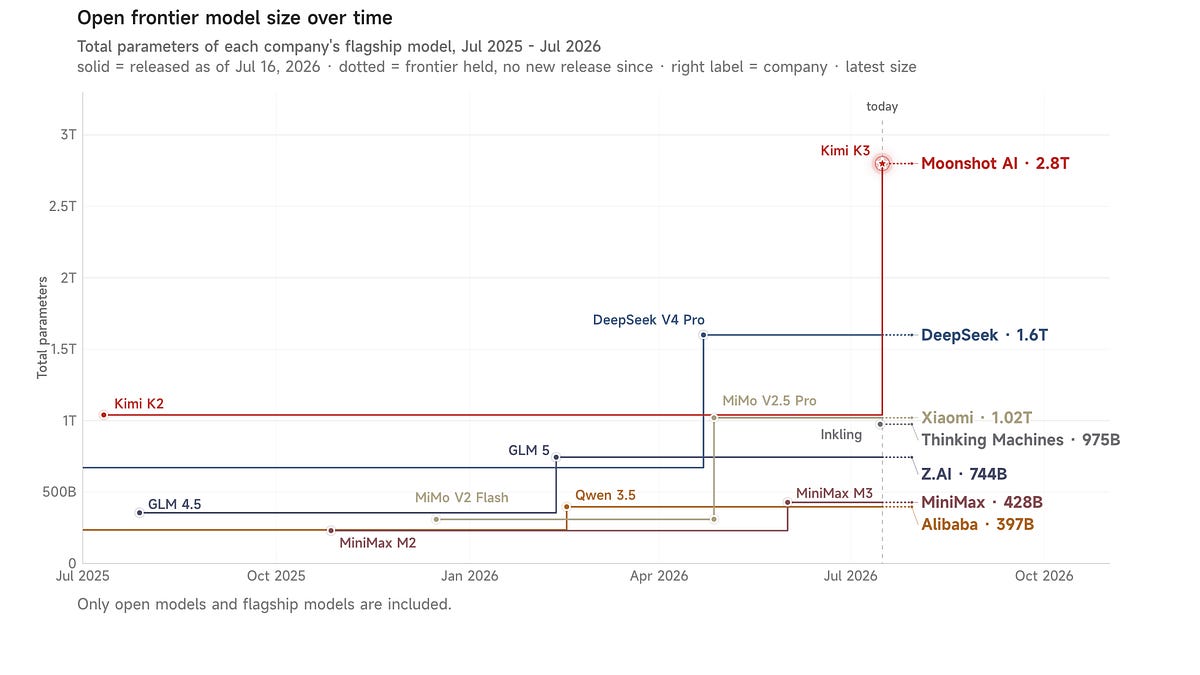
- Moonshot AI released Kimi K3, a 2.8T-parameter (A50B active) open-weights model with 1M context and native multimodal input; independent evals call it Opus 4.8/GPT-5.5-class, and it took #1 in Frontend Code Arena, though Moonshot concedes a UX gap versus Fable 5 and GPT-5.6 Sol. https://www.latent.space/p/ainews-kimi-k3-28t-a50b-the-largest
Structured Summaries
New models / research
Moonshot AI launched Kimi K3, billed as “Open Frontier Intelligence” and the largest open-weight model ever released: 2.8T total parameters (~A50B active), a 1M-token context window, and native multimodal (text + image) input, with open weights promised by July 27, 2026. Architecturally it introduces Kimi Delta Attention (KDA), claimed to enable up to 6.3x faster decoding in million-token contexts, Attention Residuals (AttnRes) for ~25% higher training efficiency at under 2% added cost, and a LatentMoE design activating 16 of 896 experts (an activation ratio under 2%). Independent evaluation from Artificial Analysis placed K3 at 57 on the AA Intelligence Index — comparable to Opus 4.8 and GPT-5.5 but behind Fable 5 and GPT-5.6 Sol — at $0.94 per task and ~21% fewer output tokens than K2.6. Arena reported K3 vaulting from #18 to #1 in Frontend Code Arena (1679 points, 76% pairwise win rate) and up to #9 in Text Arena. Moonshot itself acknowledged a “noticeable gap in user experience” versus the leading closed models. Sources: https://www.latent.space/p/ainews-kimi-k3-28t-a50b-the-largest https://simonwillison.net/2026/Jul/17/kimi-k3/#atom-everything
Research insights
Nate’s head-to-head between Codex and Fable reframes the agent question from “how well does it execute?” to “how well does it decide what deserves doing?” Given an identical open brief to inspect a real business and build the most valuable automation, Codex was the more pleasant harness and shipped a dependable evidence-handoff tool, while the more frustrating Fable identified a higher-leverage upstream problem — story selection — that its operator felt he immediately had to solve. The takeaway: as models help choose what to build, model routing moves upstream of the deliverable, splitting the “strategic” model from the “dependable” harness. Sources: https://natesnewsletter.substack.com/p/let-ai-pick-what-to-automate
Tooling
Nate packaged the experiment into a reusable automation-discovery skill: it inspects your own work behind boundaries you set and returns up to five evidenced automation offers rather than one grand answer, deliberately stopping short of building until you choose — a design decision meant to prevent a bounded agent from making its own read feel inevitable. Sources: https://natesnewsletter.substack.com/p/let-ai-pick-what-to-automate
Research insights — AI energy
On the sustainability front, Simon Willison offered a satirical fix for data-center water pressure: Google used 10.9 billion gallons in 2025 (~30M gallons/day), while each of the Coachella Valley’s 120 golf courses consumes ~750,000 gallons/day, so a hyperscaler could theoretically offset its footprint by buying ~40 courses and converting the greens into public birdwatching parks. Sources: https://simonwillison.net/2026/Jul/17/spot-birds-not-golf/#atom-everything
🔗 View this digest on the web: https://ainews.rusig.com/digests/2026-07-17-morning/