AI Digest — July 13, 2026, 8 PM
Quick Notes
- How to Help People Thrive with AI explains that while model improvements open new opportunities, supporting people in learning how to use them is essential; only 30% of employees have received agentic training despite organizations taking action on agents.
https://www.youtube.com/watch?v=bl76qV0xwec
- Anthropic Can Now Read Claude’s Mind covers UN Secretary-General Antonio Guterres calling for a ban on autonomous weaponry at the Geneva AI governance summit, emphasizing that decisions like taking human life must remain human forever despite rapid AI deployment.
https://www.youtube.com/watch?v=TgOpdC2HrE8
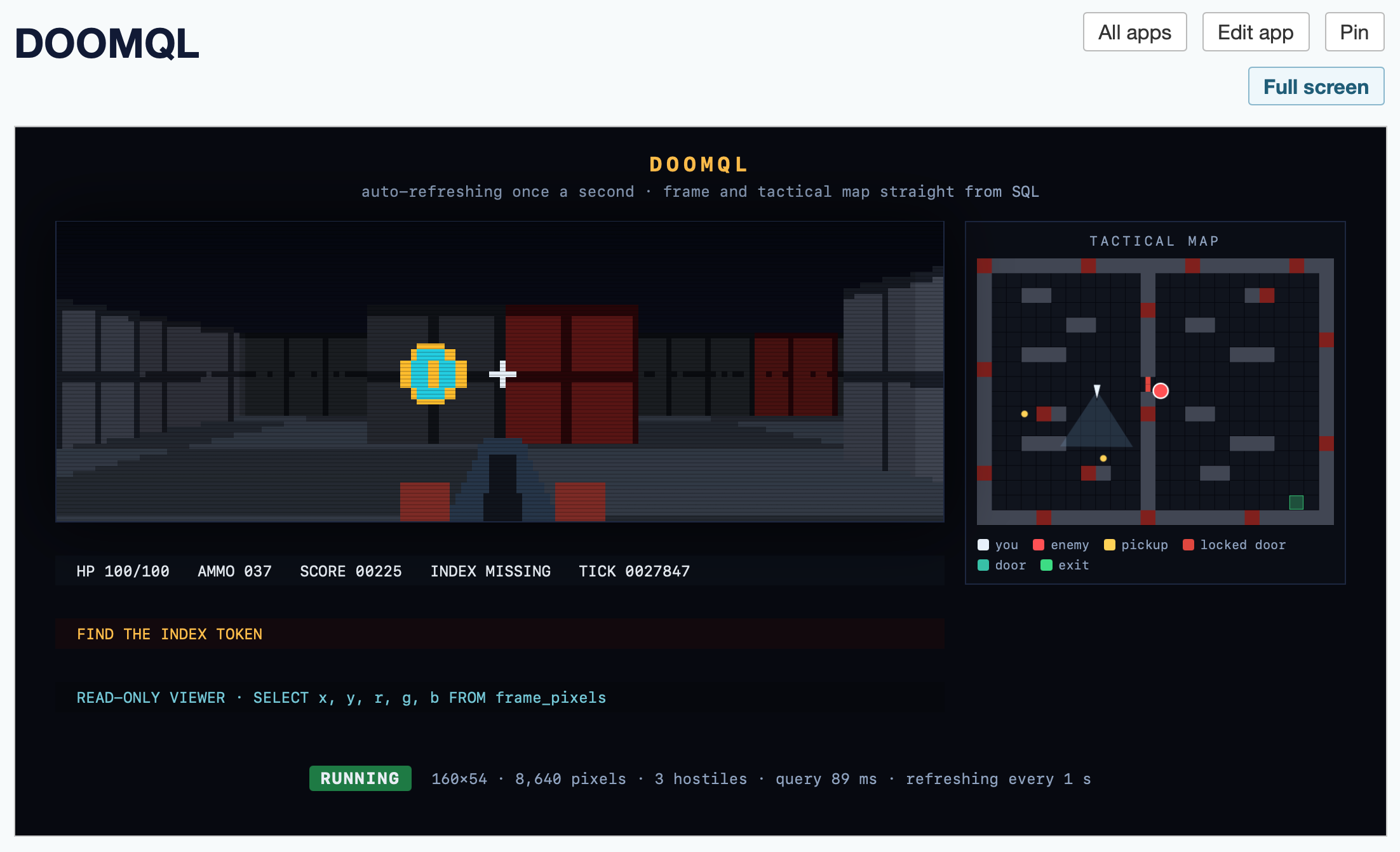
- DOOMQL presents a creative project where SQLite serves as both database and game engine, with SQL queries controlling movement, collision, enemies, combat, progression, and every pixel on screen in a Doom-like experience built using GPT-5.6 Sol and Claude chat (Fable 5).
https://simonwillison.net/2026/Jul/13/doomql/#atom-everything
-
datasette code-frequency chart on GitHub shows activity spikes aligning with Opus 4.8, GPT-5.5, Fable 5 and GPT-5.6 Sol releases demonstrating the impact of advanced coding agents on open source project development for Simon Willison’s Datasette.
https://simonwillison.net/2026/Jul/13/datasette-code-frequency/#atom-everything -
Fable 5 is the smarter model, while ChatGPT 5.6 Sol proves to be the dumber yet highly useful model for knowledge work; Nate prefers Fable when important intent sits between his words and explanation, using it to find what he meant before clearly saying it.
https://natesnewsletter.substack.com/p/pick-ai-model-how-you-work
- Your Next AI Subscription Shouldn’t Be ChatGPT 5.6 Or Fable 5. It Should Be Both explains why different models suit different work styles: users who talk through technical prompts and steer via corrections benefit from Sol, while those needing help clarifying incomplete intent prefer Fable’s ability to read between the lines.
https://www.youtube.com/watch?v=jOWXBzP6nNg
- The Briefing: AI for Science announces the launch of Cloud Science product that compresses decades of progress in biology and medicine into years, addressing slow research cycles by enabling bilingual scientific teams fluent in both their domain and digital/AI tools.
https://www.youtube.com/watch?v=cd3PsBoGYkc
Structured Summaries
Model Selection and Benchmarking
New AI model analyses emphasize that there’s no single best model for everyone—the choice depends on how you work, not raw benchmark scores alone. Nate Jones’ “Model Fit” case study reveals that Fable 5 excels at reading intent between unclear words, while ChatGPT 5.6 Sol shines in prolonged knowledge-intensive tasks where users articulate problems thoroughly. This divergence reflects the future: model selection will increasingly hinge on alignment with individual workflows rather than universal benchmarks alone. Users who think through technical prompts step-by-step will prefer models like Sol for reliable task execution; those who work from fuzzy intent and partial specs should lean toward Fable’s clarifying capability. The key insight is that “dumber” doesn’t mean worse—just differently optimized for particular use cases.
Sources: https://natesnewsletter.substack.com/p/pick-ai-model-how-you-work https://www.youtube.com/watch?v=jOWXBzP6nNg
AI Governance and Ethics
International regulatory action on AI safety is gaining momentum with the UN initiating its first global dialogue on AI governance in Geneva. Secretary-General Antonio Guterres has called for an outright ban on autonomous weaponry (“killer robots”), arguing that decisions involving human life must remain perpetually under human control despite AI’s rapid advancement. The debate centers on defining where ethical boundaries lie—particularly regarding target selection systems demonstrated during conflicts like the Iran War. While autonomous weapons have existed before LLMs, the integration of advanced AI into targeting and decision-making processes raises questions about consent and accountability in deploying transformative technology without adequate safeguards or oversight mechanisms.
Sources: https://www.youtube.com/watch?v=TgOpdC2HrE8
Scientific Acceleration through AI
AI for Science is achieving its early promises, particularly in accelerating biomedical research. Two years ago, predictions that AI could compress 50–100 years of progress in biology and medicine into just 5–10 years were viewed as ambitious—today those goals are underway with the launch of Cloud Science. This new platform tackles slow, tedious experimental cycles by providing powerful experimental science capabilities humans couldn’t conceive alone, paired with creative problem-solving that AI can’t replicate. The result: fewer “toil weeks,” more actual scientific discovery, and faster progress against undruggable disease targets.
Sources: https://www.youtube.com/watch?v=cd3PsBoGYkc
Human-Centered AI Adoption
The biggest gap in AI deployment isn’t technology but human proficiency and support. Recent data from Section’s AI proficiency report shows a troubling disconnect: 69% of organizations have taken action on agents, yet only 16% actually employ agentic tools at work, with less than 10% able to define what an AI agent is. Even starker: merely 30% of employees in organizations with AI agents receive formal training. The lesson is clear—models alone won’t drive value; meaningful adoption requires structured learning programs and organizational support for workers to confidently explore these powerful new tools.
Sources: https://www.youtube.com/watch?v=bl76qV0xwec
Developer Productivity Tools
AI-assisted development continues reshaping open source workflows, as evidenced by code frequency spikes in projects like Datasette following releases of Opus 4.8, GPT-5.5, Fable 5, and Sol. Beyond efficiency gains, developer creativity finds new expression: projects like DOOMQL demonstrate how advanced AI tools enable novel paradigms where SQL becomes the game engine itself. A full ray tracer running via recursive CTEs in SQLite, complete with movement mechanics, collision detection, enemies and combat systems rendered pixel-by-pixel—all orchestrated through SQL queries—shows what’s possible when sophisticated coding agents like GPT-5.6 Sol push the boundaries of creative technical problem-solving within established frameworks.
Sources: https://simonwillison.net/2026/Jul/13/datasette-code-frequency/#atom-everything https://simonwillison.net/2026/Jul/13/doomql/#atom-everything
🔗 View this digest on the web: https://ainews.rusig.com/digests/2026-07-13-evening/